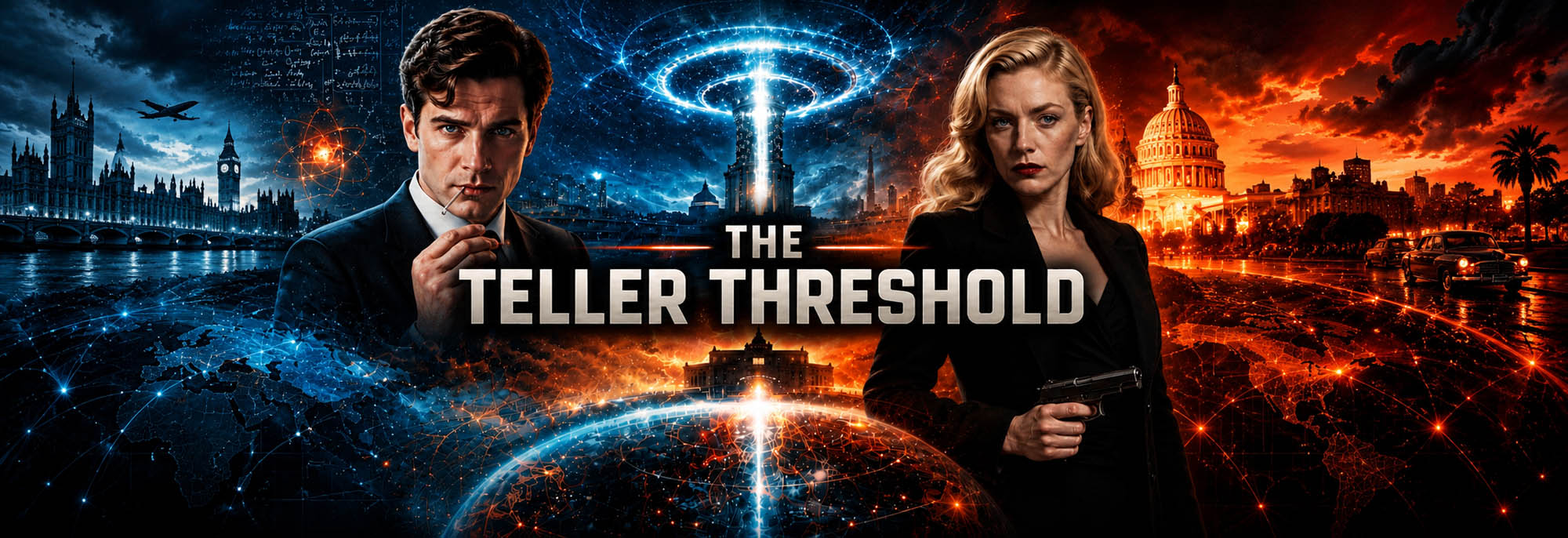
The Teller Threshold follows Giles and Lucy through a Cold War maze of espionage, science, and psychological manipulation as they confront a technology that makes consensus feel natural while erasing the freedom to choose. Why was 1955 the right historical moment for this story?
I chose 1955 because it was a fascinating year. The Cold War was shifting away from reliance on conventional weapons. The hydrogen bomb had fundamentally changed strategic thinking. The Soviet Union and the United States were trying to understand each other's intentions. Institutions on both sides were seeking certainty in an increasingly uncertain world. It's also the year when Edward Teller and the Livermore Laboratory began shaping the future of nuclear strategy.
That gave me a solid historical background. Instead of creating an entirely different history, I wanted to ask a different question. What if, alongside the race to build bigger and better weapons, there had been a quieter competition to influence the decisions that determined whether those weapons would ever be used?
That idea fascinated me because it shifts the battlefield from missiles and bombs to boardrooms and cabinet meetings. The most dangerous technology in the novel doesn't explode. It simply removes hesitation. History shows us that it has often prevented catastrophe. The Teller Threshold considers what happens when someone views hesitation as a flaw to be engineered out of human decision-making.
Giles and Lucy bring very different energies to the book. How did their partnership evolve as you wrote?
From the beginning, I never wanted Giles and Lucy to become the typical thriller duo where one handles the action, and the other offers emotional support. It wasn’t going to work. They're equals. But they approach problems in fundamentally different ways.
Giles is almost to a fault analytical. He relies on observation, logic, and careful reasoning. He believes that most crises worsen when people act too quickly. Lucy is instinctive. She reads people exceptionally well and recognizes motives long before Giles does. She's decisive without being reckless, and, unlike Giles, she's comfortable navigating the moral ambiguity that intelligence work often involves.
What I wanted to develop wasn’t the conflict between them, but how they complement one another's thinking. Giles constantly questions systems. Lucy questions people. Giles seeks evidence. Lucy observes behavior. Neither is entirely correct on their own, but they show that real understanding often comes from two smart people who are willing to challenge each other before making a decision. They're actually defending the process of disagreement itself.
The novel treats disagreement and uncertainty as safeguards rather than weaknesses. Was that theme present from the beginning?
Definitely. Meetings that end early are seen as successful. Leaders who seem decisive are admired. However, history shows that some of humanity's worst catastrophes happened because dissent was silenced at the critical moment. I became intrigued by how often the world avoided disaster because someone challenged the mainstream view. One person asking, "What if we're wrong?" has consistently changed history.
Decision Locking turns that principle on its head. It doesn't make people obey. It simply makes disagreement feel unnecessary. That idea disturbed me more because the affected people still think they have free will. No one feels controlled. They just become more convinced that everyone else must already be right.
The novel isn't really about technology. It's about the importance of friction. Democracy, science, and intelligence all rely on disagreement. Once disagreement becomes inefficient, or worse, unwanted, you lose something essential about how free societies truly work.
How did you balance real Cold War history with the speculative science at the heart of the thriller?
That was the challenge! I wanted readers to occasionally pause and wonder, "Wait… did that really happen?" It only works if the historical foundation is solid.
Every major event and every historical figure appear in the story because they truly occupied that role at that time. Edward Teller, Allen Dulles, James Angleton, Sidney Gottlieb, Livermore Laboratory, and the hydrogen bomb program aren't fictional additions. They are the framework within which the story unfolds.
In some sense, I guess I approached it more like an intelligence historian than a science-fiction thriller writer! I wasn't interested in futuristic fantasy gadgets. I wanted readers to feel that if such a technology had existed, this is exactly how governments would have classified it, how intelligence agencies would have competed for it, and how scientists would have debated its ethics.
Yes - the science is speculative, but the politics are real. Ultimately, that, I think, is what can make real Cold War storytelling so engaging. It often feels more bizarre than fiction. By inserting imagined ideas into an otherwise genuine historical setting, I wanted to encourage readers to rethink not just what happened, but why it happened, and how much of history relies on people maintaining the freedom to disagree.