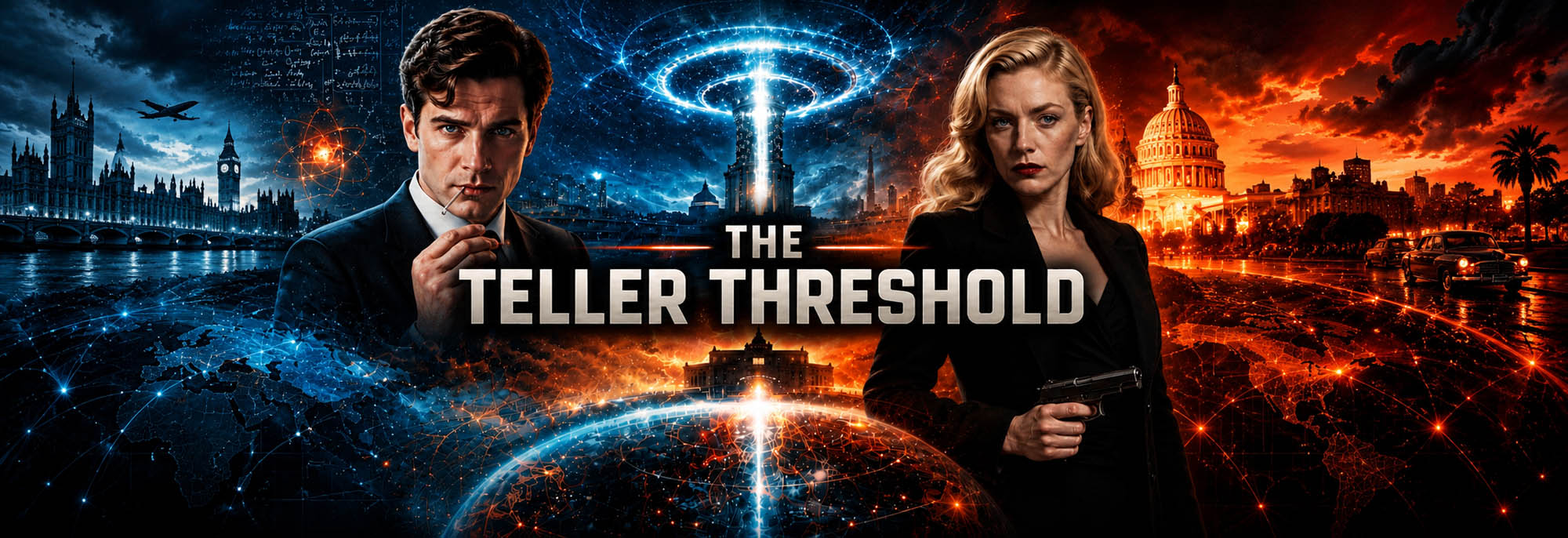
Alexander Bentley’s The Teller Threshold is a Cold War spy-fi thriller built around a
chilling idea: what happens when governments discover a way to make people agree before
they’ve truly chosen? Set in 1955, the novel follows Giles and Lucy through a web of
intelligence rooms, military tests, Soviet research sites, hidden freight routes, and
scientific briefings where the real danger isn’t just nuclear power, but the quiet
manipulation of uncertainty. It’s a book about espionage, science, and the fragile
value of disagreement.
The central concept, Decision Locking, gives the story its strongest pull. This technology
doesn’t bark orders or turn people into puppets. It narrows the range of choices until
consensus feels natural. That’s what makes it unsettling. Bentley understands that the
scariest kind of control is the kind people don’t recognize as control. The line “Names
govern conscience” captures one of the book’s sharpest ideas: once something has a name,
people are forced to confront what it really does.
Giles makes a strong narrator because he’s observant, dry, and more human than heroic.
He’s often overwhelmed, sometimes afraid, and usually trying to think his way through
events that keep moving faster than he’d like. Lucy gives the book much of its spark.
She’s blunt, capable, funny in a clipped way, and deeply sensitive to the horror of
being controlled. Their partnership keeps the story from becoming too technical, giving
the science and spycraft a steady human pulse.
The novel’s Cold War atmosphere is dense and convincing, moving from California and
Washington to Guatemala, London, Norway, and Murmansk without losing its sense of
pressure. Bentley mixes real historical figures and speculative science in a way that
feels purposeful rather than decorative. The book is at its best when committee rooms,
laboratories, and field operations all start to feel like different versions of the
same battlefield. By the end, the phrase “A tyranny by relief” lands with real force
because the story has shown how tempting certainty can be.
The Teller Threshold is a thoughtful, tense, and idea-driven thriller with plenty of
movement, but its real subject is the cost of frictionless agreement. It’s a spy novel
with science fiction machinery, a political thriller with philosophical teeth, and a
character story about people trying to preserve the messy, necessary space where doubt
still exists. Bentley has written a book that treats hesitation, argument, and uncertainty
not as weaknesses, but as safeguards worth defending.
— Literary Titan ⭐⭐⭐⭐⭐